

Project in Action
I first became aware of Booth A62 in the early evening of the initial ORF day. Our booth, A61, had continuously been running a video playlist as visual aid to the history of our project. At one point, the online playlist was suddenly unable to load and a general failure in network connection made a few dozens of heads in the hall look up from their smartphones. Within seconds, members at Booth A62 doubled their numbers and went back and forth frantically. Two of them were simultaneously connected via laptops on the servers and devices restoring configurations. Within minutes, everything was running again. In that moment, their project became completely transparent to onlookers. This was not a mere presentation or enactment, this was practical implementation of their research project.
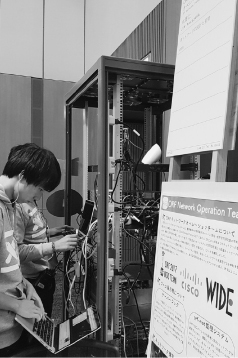
Booth A62, the Network Design and Operation project, was perhaps unique in comparison to other booths under the same project leader (A11, A17, A18, A20), and perhaps among all other exhibitors in the venue. Rather than showcasing concluded results or their “work in progress”, the ORF Network Operation Center was experimenting and testing their skill and design in what was for them “ORF the laboratory”.
Beyond the audience’s conscious perception, the whole ORF venue constituted the area of carrying out their exhibit, their so called hot-stage. In custom made hooded sweatshirts distinguishing themselves from other exhibitors and easily approachable in time of need, the members embodied transmitters of their own exhibit even when they were standing away from it. Simultaneously, their booth branched out across rooms and people, via routers, their backstage room, invisible exchange of data, every exhibitor or guest’s connected mobile device.
Yet, they were very rarely engaged with exhibitions or presentations. When other exhibitors were keeping an eye for wandering visitors or new audience, the ORF NOC team were focused on their own tasks, which mainly involved monitoring the already built setup: platforms, security, encryptions and protocols. When they had visitors, they could directly showcase their project hands-on through what they were working on, and the audience could immediately see the process or its results.
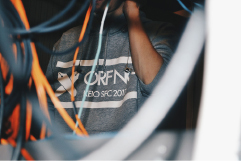

For stability of their “exhibit” and delivery of results for ORF, certain procedures needed to be maintained. These indirectly promoted teamwork and constant effective communication among the members. Hierarchy was intrinsically demanded by the encryptions, which levelled the whole team equal opposite the operator system. This characteristic was perfectly exemplified at the end of ORF, when it was time to remove the equipment and take down the setup. Most members donned wireless transmitters/receivers to coordinate the release of the encryptions and disconnect the machines, which one by one left the main room quietly. Nothing could be done outside strict order.
For NOC members, ORF2017 was a field for gaining experience in building networks, overseeing, problem-solving and general training in their methods. They connected with their audience through concurrent intricate tasks, eventually transforming both venue and visitors into crucial and indispensable parts of their experiment.